11 Expert Tips for Choosing the Right Breast Implant Surgeon
Choosing the Right Breast Implant Surgeon is one of the most important decisions in your breast augmentation journey. The surgeon you select influences treatment planning, implant selection, surgical safety, recovery support, and the overall quality of your results. For patients considering breast implant surgery in Kerala, careful research can help make the decision more informed and comfortable.
Breast augmentation is not simply about selecting an implant size. It requires a detailed understanding of breast anatomy, body proportions, skin quality, surgical techniques, and patient expectations. A qualified surgeon should create a personalised plan instead of offering the same approach to every patient.
Why Choosing the Right Breast Implant Surgeon Matters
Breast implant surgery involves placing an implant within carefully prepared breast tissue. The procedure must be planned according to the patient’s chest width, existing breast volume, skin elasticity, breast symmetry, and aesthetic goals.
Choosing the Right Breast Implant Surgeon matters because the surgeon is responsible for:
- Assessing whether you are medically suitable for surgery
- Recommending an appropriate implant type
- Selecting a suitable implant size and profile
- Planning the implant position
- Choosing the incision location
- Maintaining patient safety during surgery
- Managing early recovery
- Monitoring long-term results
- Identifying and treating complications
- Providing honest information about limitations
A well-planned procedure should aim for balanced proportions rather than simply creating the largest possible breast size.
Common Reasons for Breast Implant Surgery
Before Choosing the Right Breast Implant Surgeon, it is useful to understand the different reasons patients consider breast augmentation.
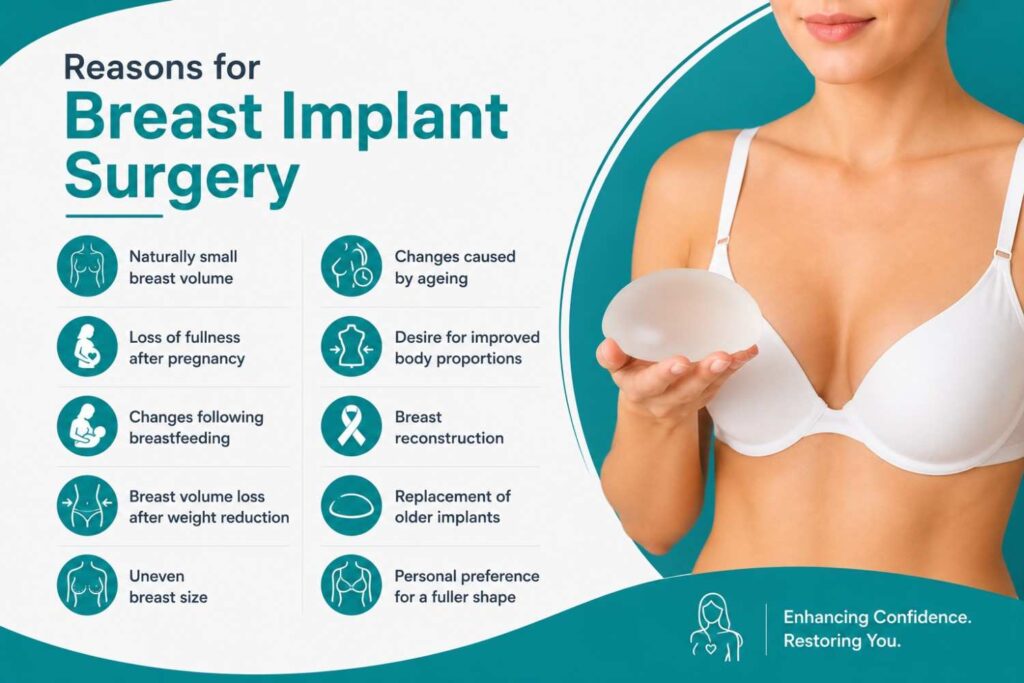
Common reasons include:
- Naturally small breast volume
- Loss of fullness after pregnancy
- Changes following breastfeeding
- Breast volume loss after weight reduction
- Uneven breast size
- Changes caused by ageing
- Desire for improved body proportions
- Breast reconstruction
- Replacement of older implants
- Personal preference for a fuller shape
The motivation for surgery should come from the patient. A responsible surgeon will ensure that the decision is voluntary and based on realistic expectations.
Types of Breast Implant Surgeons and Specialists
Patients may come across several professional titles while researching surgery. Understanding these titles is important when Choosing the Right Breast Implant Surgeon.
- Plastic and Reconstructive Surgeon
A plastic and reconstructive surgeon receives specialised surgical training in aesthetic procedures, reconstruction, wound management, tissue handling, and body contouring.
This background is relevant because breast implant surgery requires careful management of skin, breast tissue, muscle, incisions, and implant position.
- Cosmetic Surgeon
The term cosmetic surgeon may be used by doctors from different medical backgrounds. The title alone does not always confirm specialised training in plastic surgery.
Patients should verify the doctor’s recognised qualifications, surgical training, registration, and specific breast surgery experience.
- Breast Surgeon
A breast surgeon may primarily treat breast diseases, tumours, or other medical conditions. Some breast surgeons may work with plastic surgeons during reconstructive procedures.
For cosmetic breast augmentation, patients should confirm that the surgeon has appropriate training and experience in aesthetic implant surgery.
11 Tips for Choosing the Right Breast Implant Surgeon
1. Check the Surgeon’s Medical Qualifications
The first step in Choosing the Right Breast Implant Surgeon is checking recognised medical qualifications.
A surgeon should have completed formal medical education followed by appropriate postgraduate surgical training. Plastic surgery qualifications indicate focused education in reconstructive and aesthetic procedures.
Patients may ask:
- Where did the surgeon complete medical training?
- What postgraduate surgical qualifications do they hold?
- Did they complete recognised plastic surgery training?
- Are the qualifications clearly displayed?
- Can the qualifications be independently verified?
Professional titles should not replace proper qualification checks. Patients should avoid making a decision based only on social media popularity, advertisements, or attractive before-and-after photographs.
2. Confirm Professional Registration
Choosing the Right Breast Implant Surgeon also involves confirming that the doctor holds valid registration with the relevant medical authority.
Professional registration helps demonstrate that the doctor is legally recognised to practise medicine. Depending on the region, specialist registration or professional association membership may provide additional information about training.
Patients should verify details through official professional sources whenever possible.
Registration alone does not guarantee a particular result, but it is an essential starting point when evaluating a surgeon.
3. Review Breast Implant Surgery Experience
A qualified plastic surgeon may perform many procedures, but specific experience in breast implant surgery is especially important.
Patients should ask how regularly the surgeon performs breast augmentation and whether they manage different breast shapes, asymmetry, implant replacements, and revision procedures.
Useful questions include:
- How often do you perform breast implant surgery?
- Which implant placements do you commonly use?
- Do you perform breast augmentation with a lift?
- Have you treated breast asymmetry?
- Do you perform implant replacement or removal?
- How do you manage implant-related complications?
Choosing the Right Breast Implant Surgeon means finding someone who can adapt the surgical plan to individual anatomy rather than relying on one standard technique.
4. Evaluate the Consultation Process
A detailed consultation is one of the clearest signs of responsible surgical care.
The surgeon should take time to understand:
- Your reasons for considering surgery
- Your preferred breast shape
- Your expectations about size
- Your medical history
- Previous breast procedures
- Pregnancy and breastfeeding history
- Future pregnancy plans
- Current medicines
- Smoking habits
- Previous reactions to anaesthesia
During the physical assessment, the surgeon may examine breast volume, skin elasticity, nipple position, chest width, breast fold position, and existing asymmetry.
Choosing the Right Breast Implant Surgeon requires attention to how thoroughly the surgeon assesses you, not simply how confidently they speak.
5. Look for Personalised Implant Recommendations
Breast implant selection should be based on measurements and anatomy.
A personalised recommendation may consider:
- Chest width
- Breast base dimensions
- Existing tissue thickness
- Skin elasticity
- Shoulder and waist proportions
- Implant volume
- Implant width
- Implant projection
- Implant shape
- Lifestyle and physical activity
A surgeon should explain why a specific implant is recommended and how it may affect the final appearance.
Be cautious if a surgeon recommends an implant size without examining or measuring you. Choosing the Right Breast Implant Surgeon means selecting a professional who prioritises proportion and tissue safety over trends.
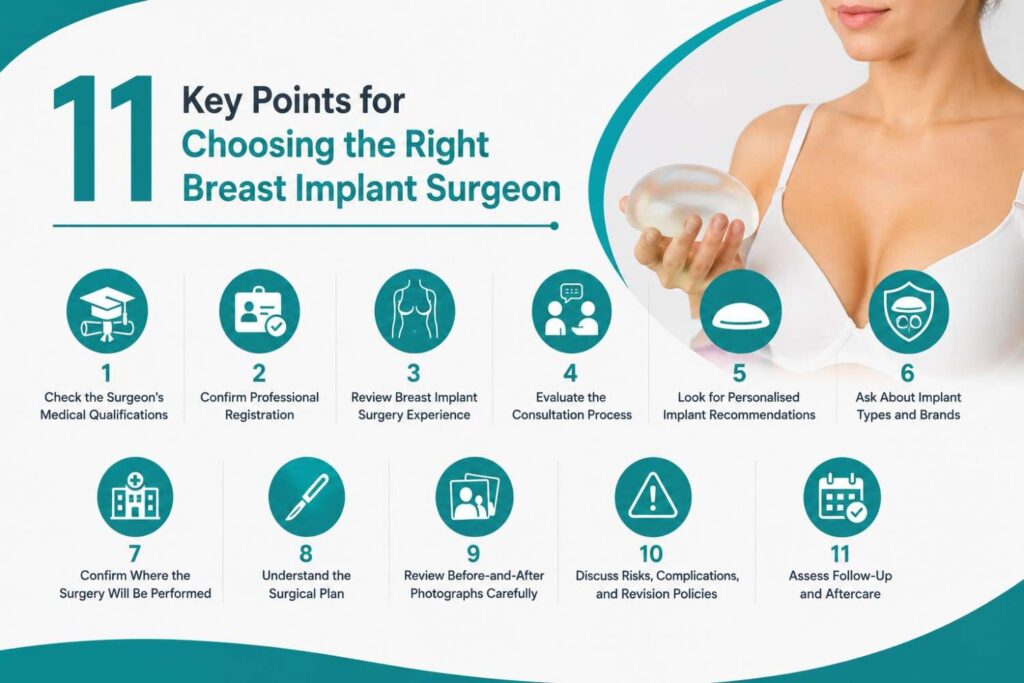
6. Ask About Implant Types and Brands
Breast implants vary in material, shape, profile, surface, and firmness.
- Silicone Implants
Silicone implants contain cohesive silicone gel and are commonly selected for their soft feel.
Saline Implants
Saline implants contain sterile salt water and may visibly lose volume if the outer shell develops a leak.
- Round Implants
Round implants may create fullness in both the upper and lower breast, depending on placement and tissue coverage.
- Anatomical Implants
Anatomical implants have a teardrop-shaped profile with greater fullness in the lower portion.
When Choosing the Right Breast Implant Surgeon, ask whether the implants come from an established manufacturer and whether you will receive implant documentation.
The surgeon should explain:
- Implant manufacturer
- Implant material
- Available sizes
- Implant profile
- Surface characteristics
- Product identification details
- Manufacturer information
- Recommended monitoring
The conversation should include both advantages and limitations rather than presenting one implant as ideal for everyone.
7. Confirm Where the Surgery Will Be Performed
The surgical environment is a major factor in Choosing the Right Breast Implant Surgeon.
Breast implant surgery should be performed in an appropriately equipped facility with established systems for anaesthesia, sterilisation, patient monitoring, emergency response, and post-operative observation.
Ask about:
- The name of the hospital or surgical facility
- Operating theatre standards
- Anaesthesia arrangements
- Qualified support staff
- Sterilisation protocols
- Recovery room facilities
- Emergency equipment
- Overnight admission options
- Post-operative monitoring
A consultation room or attractive clinic interior does not indicate the quality of the operating facility. Patients should know exactly where the procedure will take place before agreeing to surgery.
8. Understand the Surgical Plan
Choosing the Right Breast Implant Surgeon includes understanding how the procedure will be performed.
The surgeon should explain the proposed:
- Incision Location
Common incision sites include:
- The fold beneath the breast
- The edge of the areola
- The armpit
Each incision has advantages and limitations. The choice may depend on the implant type, anatomy, scar preference, and surgeon’s technique.
- Implant Placement
Breast implants may be positioned:
- Above the chest muscle
- Below the chest muscle
- Partially beneath the muscle
Placement can influence recovery, tissue coverage, movement, and appearance.
- Anaesthesia
The surgeon should explain the recommended anaesthesia and who will administer it.
- Surgery Duration
Breast implant surgery commonly takes one to two hours, but timing varies depending on the complexity of the procedure.
A responsible surgeon should make the surgical plan understandable without overwhelming the patient with unnecessary technical language.
9. Review Before-and-After Photographs Carefully
Before-and-after photographs can help patients understand the surgeon’s work, but they should be viewed realistically.
When reviewing photographs, look for patients with:
- Similar chest width
- Similar starting breast size
- Comparable breast asymmetry
- Similar skin quality
- Similar body proportions
- Similar surgical goals
Photographs of a completely different body type may not predict your possible result.
Check whether the images use consistent lighting, posture, distance, and camera angles. Excessive editing, filters, or inconsistent positioning may make comparison difficult.
Choosing the Right Breast Implant Surgeon should never depend on photographs alone. They are only one part of the decision.
10. Discuss Risks, Complications, and Revision Policies
Every surgical procedure carries potential risks. A trustworthy surgeon should explain them openly.
Possible breast implant complications include:
- Bleeding
- Infection
- Fluid collection
- Delayed wound healing
- Unfavourable scars
- Breast asymmetry
- Changes in nipple sensation
- Implant movement
- Implant rupture
- Visible implant edges
- Implant rippling
- Capsular contracture
- Anaesthesia-related complications
- Need for revision surgery
- Dissatisfaction with size or shape
Choosing the Right Breast Implant Surgeon involves selecting someone who does not avoid difficult discussions.
Ask how complications are identified, managed, and followed. You should also understand the clinic or hospital policy regarding revision procedures, professional fees, hospital charges, and implant replacement.
No ethical surgeon can promise that complications will never occur.
11. Assess Follow-Up and Aftercare
Surgical care does not end when the operation is completed.
Structured follow-up is essential for monitoring incisions, swelling, implant position, breast shape, and recovery progress.
Ask about:
- The first post-operative review
- Wound care instructions
- Support garment guidance
- Medication instructions
- Activity restrictions
- Emergency contact arrangements
- Additional follow-up visits
- Long-term implant monitoring
- Access to the surgeon after surgery
Choosing the Right Breast Implant Surgeon means finding someone who provides continued support rather than becoming difficult to contact after payment or surgery.
Warning Symptoms That Need Medical Advice
Patients should contact the surgical team if they notice:
- Increasing pain after initial improvement
- Sudden swelling in one breast
- Persistent fever
- Excessive redness
- Unusual wound discharge
- Significant bleeding
- Opening of an incision
- Breathing difficulty
- Sudden change in breast appearance
- Severe or unexpected symptoms
Choosing the Right Breast Implant Surgeon includes confirming that clear emergency instructions will be available after the operation.
Conclusion
Choosing the Right Breast Implant Surgeon requires more than comparing prices or viewing social media photographs. Patients should verify qualifications, professional registration, breast surgery experience, hospital standards, implant options, communication quality, complication management, and aftercare.
A responsible surgeon will assess your anatomy, discuss your expectations, recommend proportionate implant options, explain possible risks, and allow enough time for an informed decision. You should feel comfortable asking questions and should never feel pressured to proceed.
Anyone Choosing the Right Breast Implant Surgeon in Kerala should prioritise recognised training, personalised planning, an appropriately equipped surgical facility, transparent communication, and structured follow-up support.
For additional information about breast implants and recovery, visit the American Society of Plastic Surgeons (ASPS).
FREQUENTLY ASKED QUESTIONS
How many consultations should I attend before choosing a surgeon?
There is no fixed number. Attend enough consultations to understand your options and feel confident about your decision.
Should cost be the main factor when choosing a surgeon?
No. Qualifications, experience, hospital standards, implant quality and follow-up care are equally important.
Is a popular social media surgeon always experienced?
No. Social media popularity does not confirm recognised qualifications, surgical experience or safety standards.
Should the surgeon let me choose any implant size?
Your preference should be considered, but the implant must also suit your chest width, skin and existing tissue.
Can a surgeon guarantee natural-looking results?
No responsible surgeon can guarantee an exact result because healing, anatomy and tissue response vary.
Is breast implant surgery suitable for everyone?
No. Medical conditions, pregnancy, breastfeeding, infections, smoking or unrealistic expectations may affect suitability.
Should I ask which implant brand will be used?
Yes. Ask about the implant manufacturer, type, size, profile and relevant product information.
How important is the hospital facility?
It is very important. The facility should have proper theatres, trained staff, monitoring and emergency support.
What happens if I am unhappy with the result?
Discuss your concerns after adequate healing. Persistent issues may require observation, treatment or revision surgery.
Can I change surgeons after the consultation?
Yes. A consultation does not require you to proceed, and you may seek another opinion at any time.

Dr Prince
Consultant Plastic & Cosmetic Surgeon
Dr Prince is a Consultant Plastic and Reconstructive Surgeon at the Sushrutha Institute of Plastic Surgery, Elite Mission Hospital, Thrissur. He specializes in aesthetic and reconstructive procedures performed in a fully equipped hospital environment with strict safety protocols.
His expertise includes liposuction, rhinoplasty, gynecomastia correction, tummy tuck, breast surgery, and advanced facial aesthetic procedures, with a focus on safe techniques and natural-looking results.
Sushrutha Institute of Plastic Surgery, Elite Mission Hospital, Thrissur, Kerala